


Welcome to The Gambian Page!
Explore a unique history page where we take you on a journey through history, culture, tradition, and life.
**An Authentic Gambian Story and Journey Revealed** In December 2020, a visit to The Gambia evolved into a life-changing 3.5-month adventure. As a Black Jamaican British individual, I embraced my African roots, uncovering a deep heritage that forever transformed my identity. Come along on this meaningful journey woven with history, culture, and heritage.
The dream

the history

the legacy

kings, kingdoms and empires.
Before colonialism, the area currently referred to as The Gambia was inhabited by early kingdoms and had sophisticated social structure.
Here are several distinct hereditary class among various ethnic groups that contribute to shaping modern day Gambia.


These are only a few of the kingdoms and empires that once spanned the area we now recognize as The Gambia.


The national flag of The Gambia was designed in 1964, By an accountant named Pa Louis Thomas. It was officially adopted and first hoisted on 18 February 1965.

The Gambia first President was Sir Dawda Kairaba Jawara Presidency Term from April 24, 1970, until he was overthrown in a military coup on July 22 1994.


the power of the kola nuts


My wedding and Kola Nuts.
Kola nuts carry profound cultural importance, referred to as bossy or bizzy in Jamaica. They are brewed into bush tea for digestive relief, energy, and to treat upset stomachs and poisoning. Gambia, they are commonly found in markets and homes, playing a role in wedding customs. I remember presenting kola nuts to my father-in-law during my marriage to my wife; it was a crucial aspect of Wolof marriage tradition, symbolizing respect if he accepted them, the marriage could proceed. A friend even turned away his daughter's suitor because the kola nuts appeared rough and old.
Historical Facts
The Gambia country is named directly after the gambia river, which runs through its center.

One land splits into two countries, The Gambia and Senegal, both named after rivers, following colonialism.

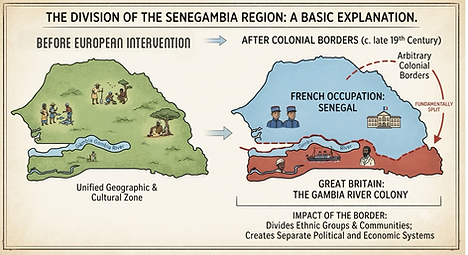
Disregarded Indigenous Borders.
Before Borders and After Borders


The Impact of the 1884-1885 Berlin Conference on Senegal and The Gambia.
Scramble for Africa, initiated by the Berlin Conference (1884-1885), led European nations to establish borders that still exist today, dividing unified regions like The Gambia and Senegal. Britain gained control of the Gambia River after a rivalry with France, culminating in an 1889 Anglo-French agreement that defined borders about 10 miles wide along the river, shaping modern Gambia.
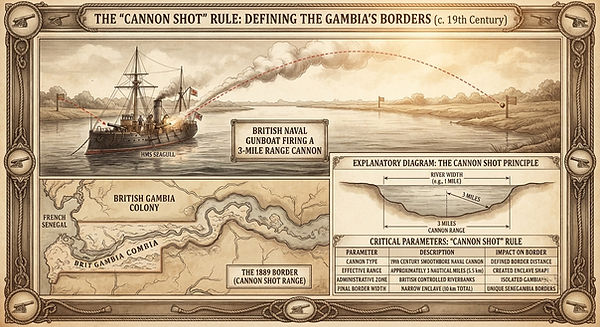
The Legend: According to popular history, a British warship navigated the Gambia River, firing cannonballs from both sides. It is said that the British laid claim to all the land within the reach of those cannonballs, thereby establishing the country's borders.


First Europeans to reach The Gambia.

The Gambia is the smallest country on the mainland of Africa.
The Gambia Cannonballs Borders.
two countries one land.
The Gambia is the tiniest country in mainland Africa, even smaller than Yorkshire! This elongated strip of land runs alongside the River Gambia and is located on west coast of Africa, flanked by Senegal on both sides. Despite its limited width of less than 30 miles at its broadest point, the country has a high population density, housing around 2.28 million residents.
First Contact: In 1446, the Portuguese became the first Europeans to arrive in Gambia, guided by explorer Dinis Dias. • Trade Relations: They initiated trade with local tribes, focusing on gold, ivory, and the slave trade. • Cultural Exchange: They brought new goods ideas, which impacted local customs. • Competition: Other European nations, including the British and Dutch, later vied for control, resulting in conflicts. • Historical Impact: This early encounter represented a crucial turning point for trade and European influence in West Africa, significantly shaping Gambia future.
Did you know that Portugal was the first European country to make contact with The Gambia in 1446?

The Gambian coat of arms features a shield representing the Gambia River, flanked by two African fish eagles symbolizing strength and freedom. Its motto is "Progress, Peace, and Prosperity," while agricultural like a hoe and sheaf represent farming. The colors green, blue, and yellow signify agriculture, the river, and resources.

The Gambian Coat of Arms signifies.
Anglo French colonnial agreements with England signed 1oth August 1889.
Purpose: To establish spheres of influence between Britain (Gambia) and (Senegal). - Key treaty: The Anglo-French Convention August 10, 1889, which defined much of the Gambia-Senegal boundary. - Adjustment Additional changes were made through the Anglo-French Convention on April 8, 1904. - Result: The Gambia emerged as a narrow British enclave along the Gambia River, encircled by French Senegal, which influenced the current borders.
Language and Translation each one teach one.


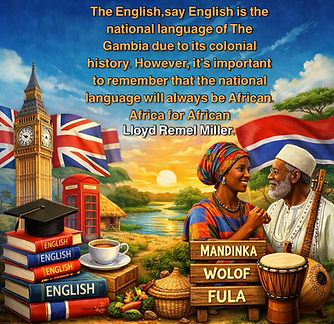
“I stayed in The Gambia for three and a half months, and since then,I have traveled back and forth every year. The language I hear most often is Wolof, as many of he other tribes also speak it. However, English is widely spoken in schools and tourist areas.”
Various languages spoken in The Gambia.


the only two countries, in the world to start their name with The.


